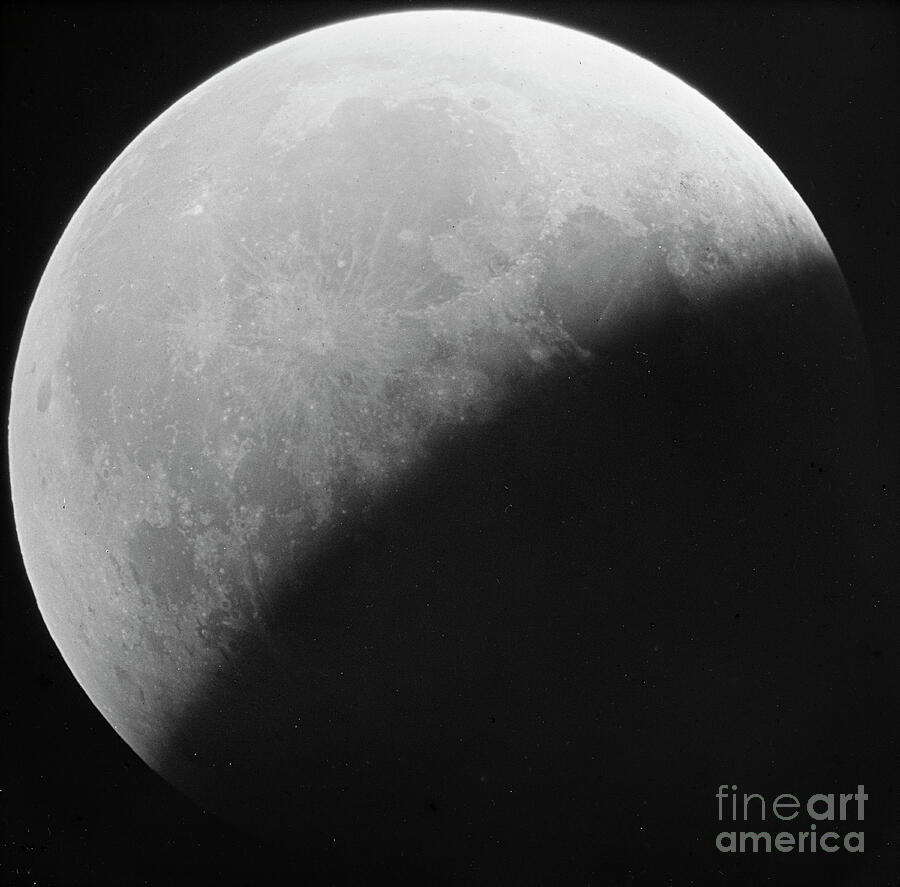
A total lunar eclipse occurred at the Moon’s descending node of orbit on Tuesday, May 24, 1910, with an umbral magnitude of 1.0950. A lunar eclipse occurs when the Moon moves into the Earth's shadow, causing the Moon to be darkened. A total lunar eclipse occurs when the Moon's near side entirely passes into the Earth's umbral shadow. Unlike a solar eclipse, which can only be viewed from a relatively small area of the world, a lunar eclipse may be viewed from anywhere on the night side of Earth. A total lunar eclipse can last up to nearly two hours, while a total solar eclipse lasts only a few minutes at any given place, because the Moon's shadow is smaller. Occurring about 2.4 days after apogee (on May 21, 1910, at 18:30 UTC), the Moon's apparent diameter was smaller.
This lunar eclipse was the third of a tetrad, with four total lunar eclipses in series, the others being on June 4, 1909; November 27, 1909; and November 17, 1910.
Visibility
The eclipse was completely visible over much of North America, South America, and Antarctica, seen rising over northwestern North America, eastern Australia, and the central Pacific Ocean and setting over Africa and Europe.
Eclipse details
Shown below is a table displaying details about this particular solar eclipse. It describes various parameters pertaining to this eclipse.
Eclipse season
This eclipse is part of an eclipse season, a period, roughly every six months, when eclipses occur. Only two (or occasionally three) eclipse seasons occur each year, and each season lasts about 35 days and repeats just short of six months (173 days) later; thus two full eclipse seasons always occur each year. Either two or three eclipses happen each eclipse season. In the sequence below, each eclipse is separated by a fortnight. The first and last eclipse in this sequence is separated by one synodic month.
Related eclipses
Eclipses in 1910
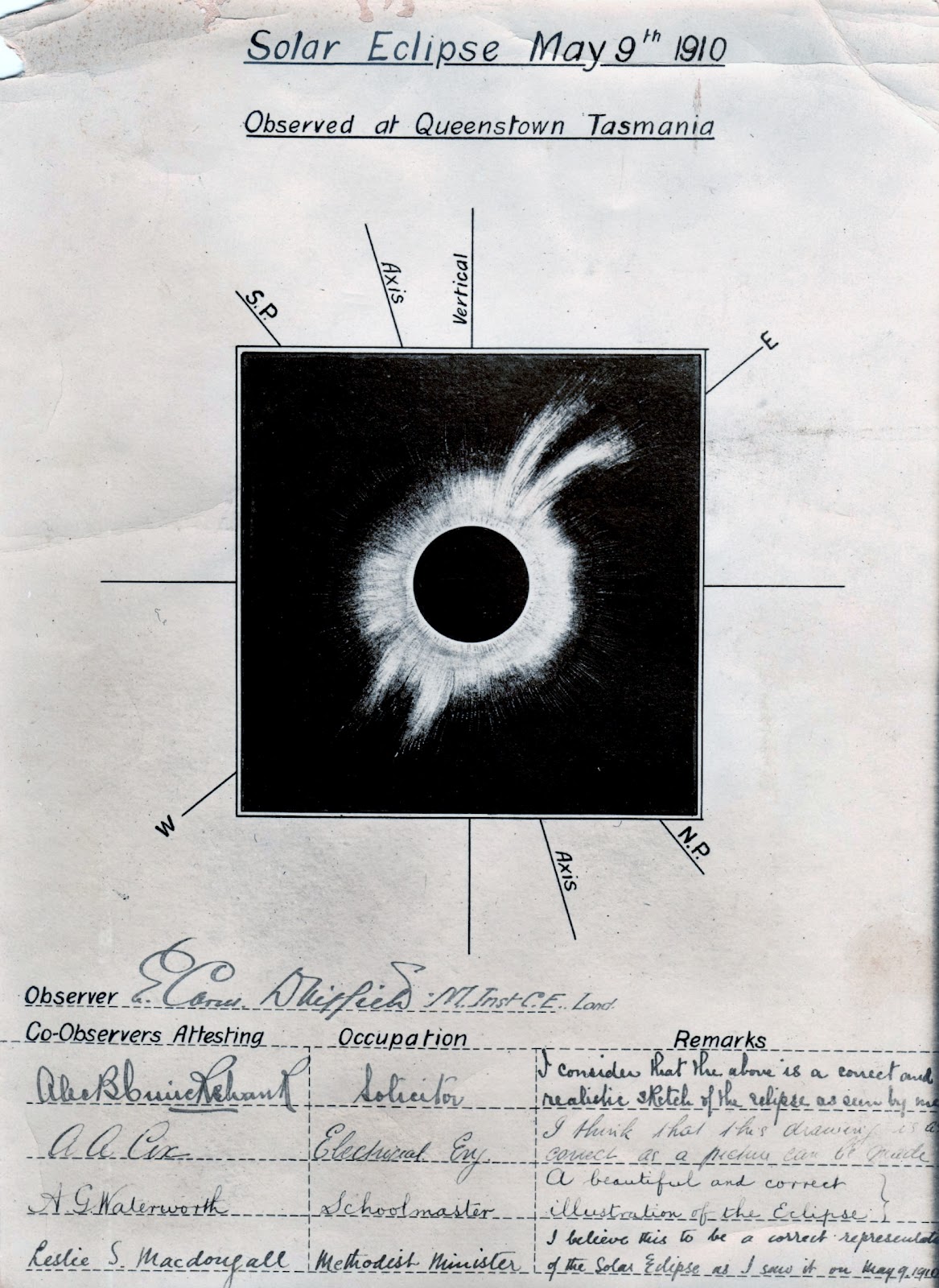
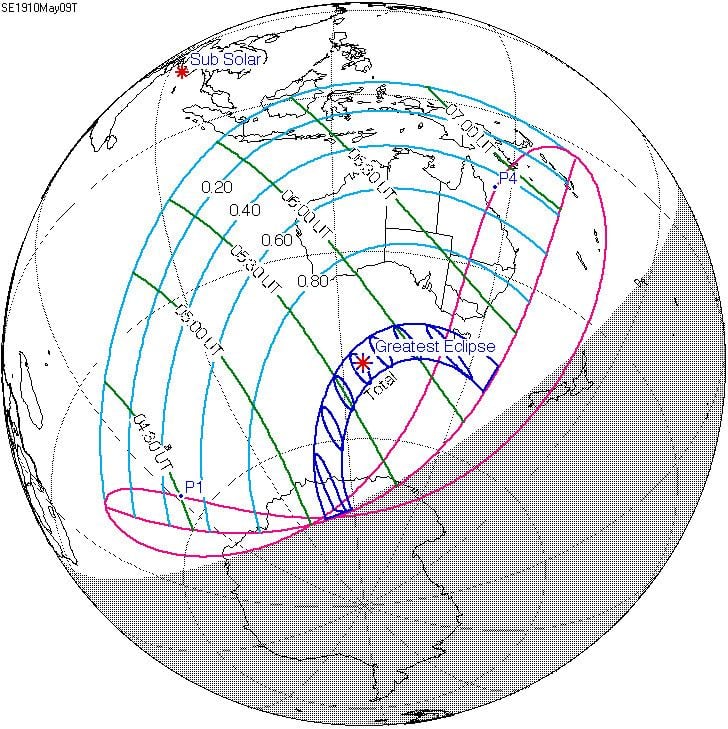
- A total solar eclipse on May 9.
- A total lunar eclipse on May 24.
- A partial solar eclipse on November 2.
- A total lunar eclipse on November 17.
Metonic
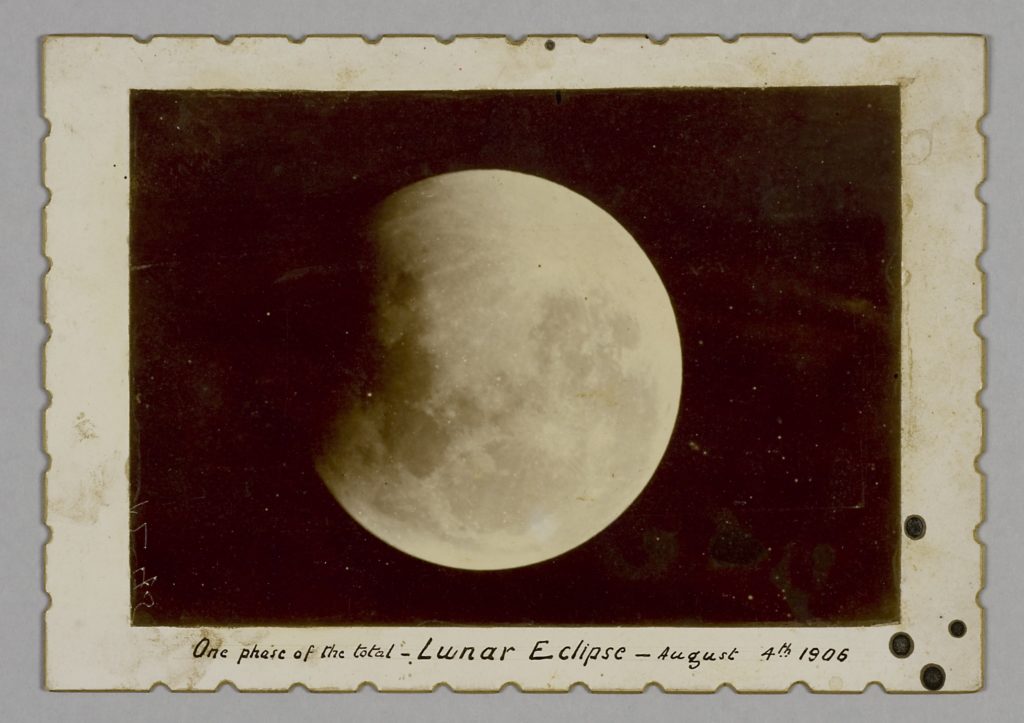
- Preceded by: Lunar eclipse of August 4, 1906
- Followed by: Lunar eclipse of March 12, 1914
Tzolkinex
- Preceded by: Lunar eclipse of April 12, 1903
- Followed by: Lunar eclipse of July 4, 1917
Half-Saros
- Preceded by: Solar eclipse of May 18, 1901
- Followed by: Solar eclipse of May 29, 1919
Tritos
- Preceded by: Lunar eclipse of June 23, 1899
- Followed by: Lunar eclipse of April 22, 1921
Lunar Saros 129
- Preceded by: Lunar eclipse of May 11, 1892
- Followed by: Lunar eclipse of June 3, 1928
Inex
- Preceded by: Lunar eclipse of June 12, 1881
- Followed by: Lunar eclipse of May 3, 1939
Triad
- Preceded by: Lunar eclipse of July 23, 1823
- Followed by: Lunar eclipse of March 24, 1997
Lunar eclipses of 1908–1911
This eclipse is a member of a semester series. An eclipse in a semester series of lunar eclipses repeats approximately every 177 days and 4 hours (a semester) at alternating nodes of the Moon's orbit.
The penumbral lunar eclipses on January 18, 1908 and July 13, 1908 occur in the previous lunar year eclipse set.
Saros 129
This eclipse is a part of Saros series 129, repeating every 18 years, 11 days, and containing 71 events. The series started with a penumbral lunar eclipse on June 10, 1351. It contains partial eclipses from September 26, 1531 through May 11, 1892; total eclipses from May 24, 1910 through September 8, 2090; and a second set of partial eclipses from September 20, 2108 through April 26, 2469. The series ends at member 71 as a penumbral eclipse on July 24, 2613.
The longest duration of totality was produced by member 37 at 106 minutes, 24 seconds on July 16, 2000. All eclipses in this series occur at the Moon’s descending node of orbit.
Eclipses are tabulated in three columns; every third eclipse in the same column is one exeligmos apart, so they all cast shadows over approximately the same parts of the Earth.
Tritos series
This eclipse is a part of a tritos cycle, repeating at alternating nodes every 135 synodic months (≈ 3986.63 days, or 11 years minus 1 month). Their appearance and longitude are irregular due to a lack of synchronization with the anomalistic month (period of perigee), but groupings of 3 tritos cycles (≈ 33 years minus 3 months) come close (≈ 434.044 anomalistic months), so eclipses are similar in these groupings.
Inex series
This eclipse is a part of the long period inex cycle, repeating at alternating nodes, every 358 synodic months (≈ 10,571.95 days, or 29 years minus 20 days). Their appearance and longitude are irregular due to a lack of synchronization with the anomalistic month (period of perigee). However, groupings of 3 inex cycles (≈ 87 years minus 2 months) comes close (≈ 1,151.02 anomalistic months), so eclipses are similar in these groupings.
Half-Saros cycle
A lunar eclipse will be preceded and followed by solar eclipses by 9 years and 5.5 days (a half saros). This lunar eclipse is related to two total solar eclipses of Solar Saros 136.
See also
- List of lunar eclipses
- List of 20th-century lunar eclipses
Notes
External links
- 1910 May 24 chart Eclipse Predictions by Fred Espenak, NASA/GSFC