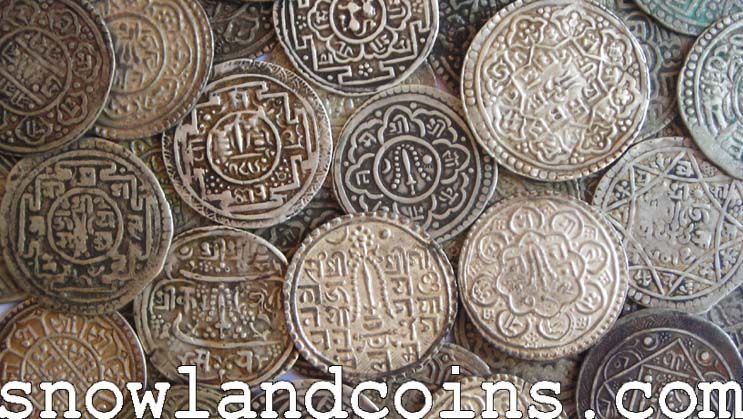
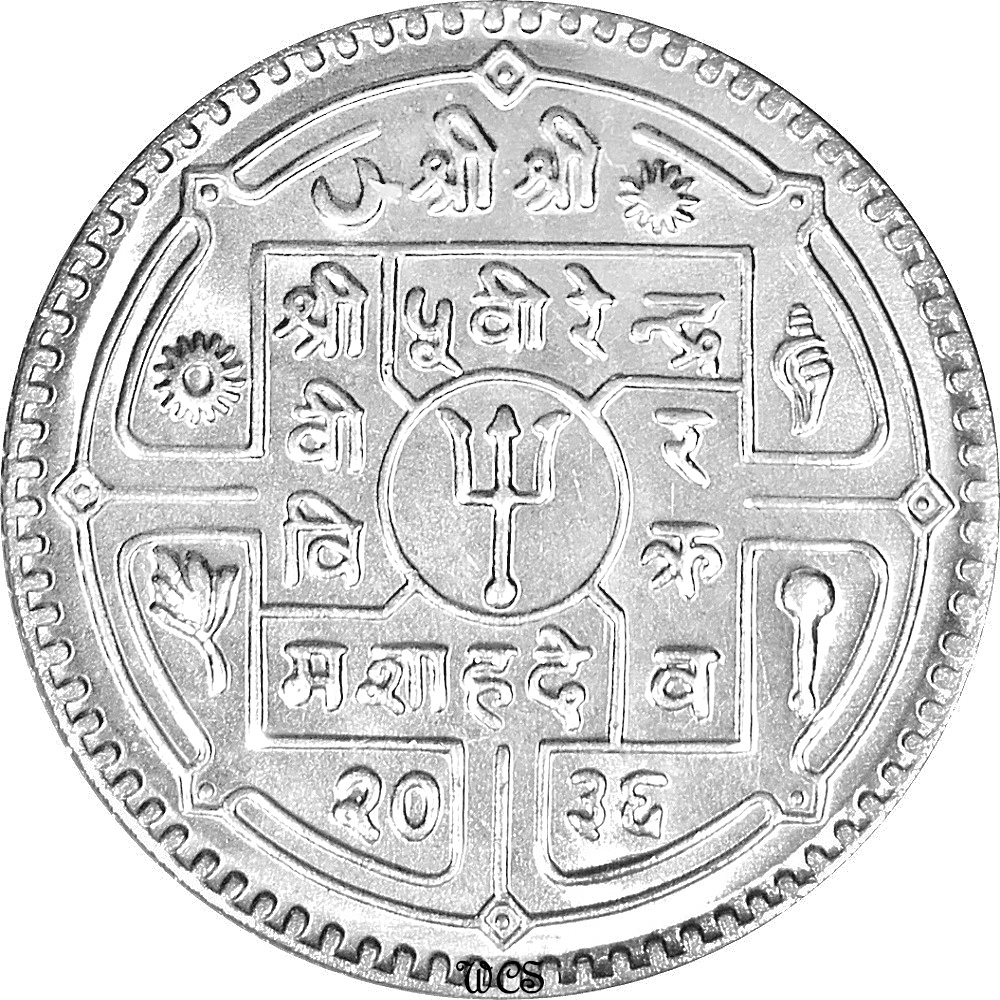
The earliest coin minted in today's territory of Nepal was in Shakya Mahajanapada, along the India–Nepal border at around 500 BCE. Shakya coins were an example of a coin invented in the Indian subcontinent which continued to be used in Nepal alongside India for over 1500 years.
Coins from Indian Subcontinent
Post-Maha Janapadas period (c. BCE 600–?)
In the Maurya Empire, punch marks were widely used in the southern region of Nepal and also imported from hills and the Kathmandu valley. Mauryan coins were punch-marked with the royal standard to ascertain their authenticity.
Kushan Empires (c. CE 30–375)
The Kushan Empire expanded into Nepal in the early 1st century CE and introduced Kushan coins. They were used in the Southern region widely and made of copper.
Classical period of Nepal (c. CE 576–750)
Lichhavi Dynasty
The Licchavi Kingdom of Nepal established its root in the Kathmandu Valley from c. CE 576 to 750. This marked the beginning of the Classical period of Nepal. Lichhavi Coins were the first coins widely used in the Kathmandu Valley and its surrounding hills.
Medieval period (c. CE 750–1540)
Malla Dynasty (c. CE 1540–1768)
Tankas Standard
Mohar Standard
After a major reform in coinage, a new style of silver coins called Mohar (Initially called Mhendramalli) were struck in Nepal with a reduced weight standard of 5.4 g. in silver.
Shah Dynasty (CE.1747–2008)
Prithvi Narayan Shah before the conquest of the Valley
After the conquest of the Valley
Regent Queen
Copper coinage in Valley
In CE. 1865, the first copper coins were issued for the Kathmandu Valley in the denomination of Copper Paisa, Double Paisa and Dam with inscription in Devanagari script.
System
Tanka standard
- 1 Tanka
- 1⁄4 Tanka
- 1⁄32 Tanka = 4 Dam
- 1 Dam = 4 Jawa
Silver Mohar system (after 1640)
- Double Rupee = 4 Mohar
- 1 Rupee /Double Mohar = 2 Mohar
- 1 Mohar = 2 Suka
- 1 Suka = 6.25 Aana
- 1 Aana = 2 Adha-aana
- 1 Adha-aana = 2 paisa
- 1 Paisa Mohar = 4 Dams
- 1 Dam = 4 Jawa
Copper standard
- 1 Ganda or Ani/Aana = 2 Dyak or 2 Double Paisa
- 1 Dyak or 1 Double Paisa = 2 Dhebua or 2 Paisa
- 1 Dhebua/Paisa = 4 Dam (Copper)
Gold coin system
- Duitole Asarfi = 4 Mohar = 2 Tolas = 360 troy grains
- Bakla Asarfi = 2 Mohar = 1 Tola = 180 troy grains
- Patla/Majhawala Asarfi = 1 Mohar = 1⁄2 Tola = 90 troy grains
- Suka Asarfi = 1⁄2 Mohar= 1⁄4 Tola = 45 troy grains
- Suki = 1⁄8 Mohar= 1⁄16 Tola = 22.5 troy grains
- Ani = 1⁄16 Mohar = 1⁄32 Tola = 2.93 troy grains
- Adha-Ani = 1⁄32 Mohar = 1⁄64 Tola = 5.87 troy grains
- Pal = 1⁄64 Mohar = 1⁄128 Tola = 2.93 troy grains
- Dam = 1⁄154 Mohar = 1⁄317 Tola = 0.71 troy grains
Gallery
See also
- Historical money of Tibet
External links
- "Notes and Coins of Nepal" (PDF). Nepal Rastra Bank. Archived from the original (PDF) on 26 February 2012. Retrieved 24 November 2016.
References